
You love plants. You just always forget to water them.
I was a terracotta girl for years. Cheap, cheerful, easy to match — what’s not to love? Well, I’ll tell you what’s not to love: I’m a chronic underwaterer, and terracotta dries out.
Fast.
I killed a lot of plants before I finally admitted that the pots were not the problem. I was the problem.
Enter self-watering plant pots. They’re not magic — I want to be upfront about that — but for busy people who love plants and are slightly rubbish at remembering to water them, they are genuinely life-changing.
I’ve been using and testing self-watering pots for years, and this is my roundup of the best ones.
Right, let’s get into it.
Right, if you’re a skimmer — this is for you — here’s every pot in one place. Tested by me (kinda), ranked by how much I’d actually recommend them. Affiliate links are marked clearly — I only link to products I’ve used or thought I had.


What actually is a self-watering pot — and how do they work?
A self-watering pot has two parts: an outer pot that holds a water reservoir at the bottom, and an inner pot where your plant actually lives.
Water travels from the reservoir up into the soil incredibly slowly — either via a wick cord, LECA, or another porous medium — delivering moisture directly to the roots over time.
Here’s my extremely professional diagram:

The technical term for this is sub-irrigation, which sounds fancy but really just means “water goes in the bottom, roots drink it from below.” The big win is that the top of the soil stays drier, which means fewer fungus gnats and less chance of overwatering.
One thing I need to say loudly for the people in the back: self-watering does not mean never-watering.
I know, I’m as mad about it as you are.
You still need to top up the reservoir. The difference is you’re doing it every couple of weeks instead of every few days. That’s it. That’s the magic.
Most self-watering pots also have a water level indicator — a little window or float that tells you when the reservoir is running low. This is genuinely useful and worth looking for when you’re buying.
Right, now let’s get to the good stuff.
The best self-watering posts – tested and ranked
Best overall – Elho Insert
- Pretty cheap
- Sturdy
- Easy to assemble (and I am NOT a natural assembler)
- Elho are a pretty cool company
- A tonne of sizes
- You can opt to buy a pot with it or not
- Suitable for any substrate – soil or semi -hydro
I don’t think I have any cons.
Oh, they only really do the one shape, so if you have a crawler, go for the Lechuza.
There are cheaper options which are fine but this is a super solid choice.
Lechuza – best for big, statement plants
Lechuza are the premium option and yes, you feel it in your wallet. But they’re also the ones I keep coming back to for larger plants, and for good reason.
They come with clear instructions, a wide range of shapes and sizes, and they’re super sturdy sturdy — important when you’ve got an ginormous Philodendron Golden Dragon with a *whimsical* growth pattern living in one (we’ve decided it’s charming).

You can also get long lechuza pots for crawling Philodendrons (though I use mine for my peace lily).
My favourite for beginners is the Lechuza Cube — you literally drop your nursery pot straight in, add water, and you’re done. No repotting. No faffing. They also include pon in the base which acts as a barrier between the water and the soil AND has fertiliser added to it. Awesome for us lazies.

If you have trailing or crawling plants — I use mine for my peace lily — the Lechuza rectangle is brilliant. It’s exactly the same design and set up as the cube but, er, longer.
T4U String Style – best budget pick for small plants
Simple, cheap, and they do exactly what they say on the tin. You fill up the reservoir and a cord wicks the water up into the soil. That’s it.

They’re perfect for small to medium plants — the largest size is about 15cm in diameter, so don’t expect to be potting up your Monstera in one. But for smaller plants?
Cheap and cheerful and absolutely fine.
A note on the T4U Lechuza-style knockoff (different product — easy to confuse): I had a bad time with those.
The design makes no sense — no inner pot, a weird raised plinth with a hole, and no good way to fill the reservoir without soaking the substrate.
I have four of them. I use them as cachepots but I wouldn’t buy them again.
That said — T4U have apparently redesigned them and now do a version with an inner pot. I haven’t tested the new one yet. I’m cautiously optimistic. and will report back 🫡.
And if a pot doesn’t work as intended, remember: it can always just be a regular pot.
The DIY Option – an Ikea pot, a nursery pot & some string
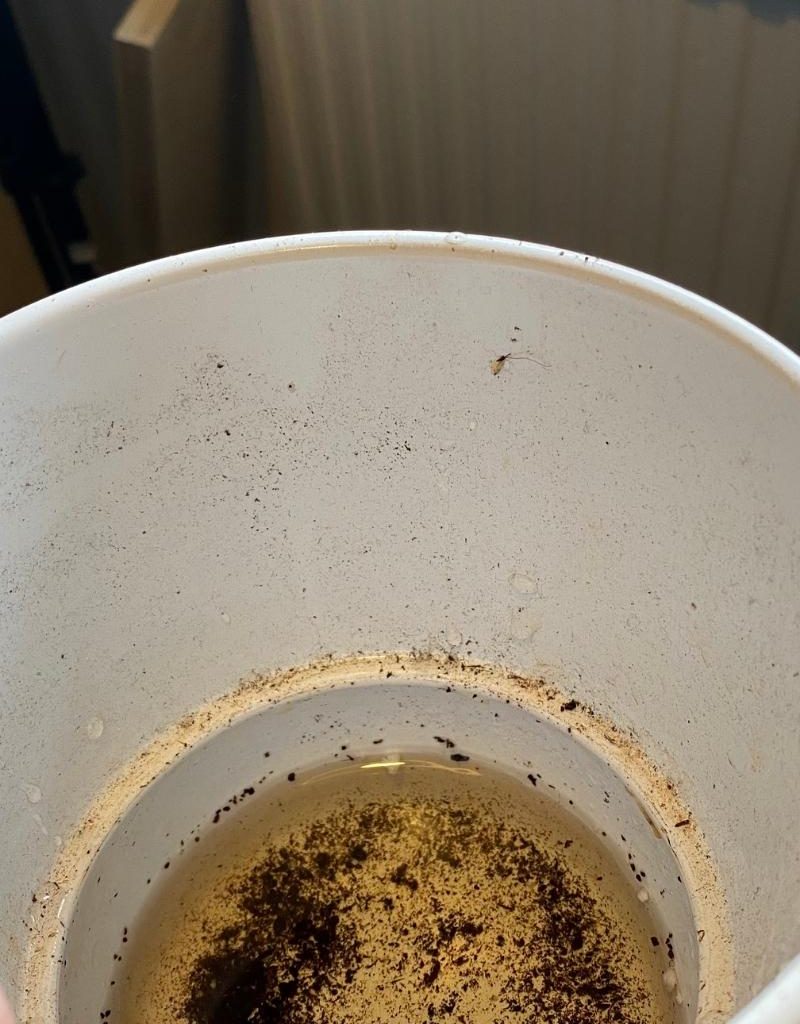
Please excuse the dirt, I just grabbed this off the windowsill so I could show you.
You know those Ikea pots with the little ridge at the bottom?
You can sit a nursery pot on that shelf, thread a piece of cotton cord through the drainage holes so it dangles into the water below, add your soil, add your plant, done.
If you’re using 100% LECA or pon you don’t even need the string — just raise the reservoir so it touches the bottom of the medium.
Which self-watering pot is right for you?
Quick version:
- Small plants, tight budget: T4U string style — can’t go wrong
- You already have pots you love: Elho insert — just add it in
- Large or statement plants: Lechuza Classico — worth the price
- Crawling or trailing plants: Lechuza rectangle
- Absolute zero budget: Ikea pot + nursery pot + cotton string
Are self-watering pots good for Monstera?
Yes — with a few things worth knowing first.
Monstera in low light + self-watering pot = watch it carefully
Monstera are frequently described as low-light plants, but honestly they’ll take as much light as you can throw at them — they just won’t die in low light. A Monstera in bright light and a self-watering pot is a brilliant combination: it’ll grow fast, drink consistently, and be very happy.
A Monstera in low light won’t use much water, the soil will stay wet for longer, and that’s where root rot risk creeps in. You can still use a self-watering pot — just make sure the reservoir is pretty empty before you refill it. And get one with a fill chute rather than watering through the top, to keep the surface dry and avoid fungus gnats.
Lechuza is your best bet here — the sizes go up big enough to suit a mature Monstera, and the water level indicator means you’re not guessing.
Keep a close eye over winter
In winter, lower light and cooler temperatures mean the soil stays damp for much longer — sometimes months. Monstera aren’t particularly prone to root rot (except Thai Constellation, which I’ve moved to water entirely because it’s the only way I can keep a root system on it), but self-watering pots can tip the balance if you’re not paying attention. In winter, just water sparingly rather than filling the reservoir.
Soil matters more than usual
In bright light, Monstera aren’t that fussy about their soil.
In a self-watering pot in lower light, chunky and well-aerated is non-negotiable — dense soil plus a constant water source plus low light is an excellent recipe for root rot. Add perlite and bark. Chunk it up.
High humidity needs balancing
High humidity can be transformative for growing big, mature plants — but paired with low temperatures and a self-watering pot keeping the soil consistently damp, you’re increasing the risk of fungal issues like powdery mildew and bacterial infections. If your room is cold and dark in winter, dial back the humidity and water manually rather than filling the reservoir.
Do self-watering pots actually work? Honest answer.
Yes — but they’re not a silver bullet and I’d be doing you a disservice if I pretended otherwise.
They work brilliantly if: you’re a chronic underwaterer, you travel a lot, or you have moisture-loving plants like peace lilies or calathea.
They need more thought if: you’re an overwaterer, you have succulents, cacti, snake plants, or ZZ plants (more on that below), or it’s winter and your home is cold and dark.
The one quirky thing they do — entirely neutral but worth knowing — is encourage roots to grow downwards toward the reservoir faster than they normally would. Roots seek moisture, so they will. It just means you might find roots poking out of the bottom sooner than expected. You don’t need to do anything about it, it just happens.
- Everything you need to know about powdery mildew
- Does my houseplant have a bacterial infection?
- Should I cut the leaves of Monstera?
Does self-watering wick cord actually work?
It does, with caveats. Wick cord is made from an absorbent material — usually cotton — with one end sitting in the water reservoir and the rest threaded through the pot and into the substrate. It wicks water up slowly, delivering moisture to the roots over time.
The limitation is that it’s just not that powerful. It works well for small pots — I wouldn’t buy a wicking pot over about 10cm diameter because the wick can’t move enough water to make a real difference in a larger pot. There’s also a four-inch rule: science suggests wick cord can only shift water effectively across about four inches, so there needs to be less than four inches between the reservoir and the substrate. Which also, for the record, is why that article you read about running strings from your sink to all your plant pots while you’re on holiday is absolute rubbish. It won’t work.
For LECA specifically: personally I don’t find wick cord effective enough. Just have the reservoir touch the bottom of the LECA and let it do its thing.
Do you need to seal the ends of the wick cord? I like to set fire to things as much as the next person, but no. Sealing the ends with a lighter to prevent bacteria isn’t going to make a meaningful difference. Save yourself the drama.
H2.6 — Which plants should (and shouldn’t) go in self-watering pots
Technically any plant can go in a self-watering pot — but the ones that do best are plants that like consistent moisture and don’t need to fully dry out between waterings.
Great candidates:
- Peace lily — loves moisture, will absolutely tell you when it’s thirsty by dramatically collapsing
- Calathea — hates everything, but drying out most of all
- Monstera — incredibly chill, decades of being bred for adaptability
- Pothos, Schefflera, Aspidistra, Dracaena — all pretty hardy and forgiving
Plants to keep OUT of self-watering pots:
- Succulents and cacti — need to dry out completely between waterings. A reservoir is their nightmare.
- Snake plants (Sansevieria) — same story. They want neglect, not moisture.
- ZZ plants — drought-tolerant to the core. Don’t do this to them.
The rule of thumb: if the care guide says “let it dry out completely before watering,” a self-watering pot is not its friend UNLESS it’s in a hydroponic or semi-hydroponic system.
How to set up your self-watering pot
The basic steps are the same across most self-watering pots:
- Thread your wick cord through the holes in the inner pot so one end hangs into the reservoir below. If using LECA with no wick, skip this step.
- Add a layer of pon or LECA to the bottom of the inner pot — this acts as a barrier between the water and the soil.
- Add your potting mix on top. Make sure it’s chunky and well-aerated — dense soil in a self-watering pot is asking for trouble.
- Pop your plant in, fill in around the roots, and water lightly from the top to help the soil settle.
- Fill the reservoir via the fill chute if your pot has one, or carefully pour around the edge. The water level indicator will tell you when it’s full.
- After the initial setup, only top up the reservoir when it’s nearly empty — don’t keep it constantly full.
For the DIY Ikea version: sit a nursery pot on the shelf inside the outer pot, thread cotton cord through the drainage holes so it dangles into the water below, add your medium, add your plant. Full video here if you want to see it done properly:
Final verdict
If you’re a busy person who loves plants and keeps accidentally killing them through neglect rather than enthusiasm — self-watering pots are for you. They won’t replace good plant care entirely, but they’ll give you enough wiggle room that forgetting for two weeks doesn’t mean a funeral.
My honest starting point: grab the Elho insert if you already have pots you love, or the Lechuza Cube if you want something that does everything out of the box. Both will change your plant life.
Got a self-watering pot I haven’t tried? Tell me about it in the comments. And if you want to defend a pot I’ve besmirched — also the comments. I can take it.
While you’re here:

Thank you for this article! What do you think of those self watering planters where instead of a cachepot, it is a cache bottom. Instead of inner net pot and outer cache pot, it is just one pot that sits on top of the reservoir, and usually there is a watering entrance you can water directly to the bottom.
One major problem is that you can’t do the 1/3 submerged Leca method as the reservoir simply doesn’t go up that high. But I’m fine with that, and prefer using a cut up cloth to wick anyway. I’m honestly not sure why that cloth method isn’t more popular. You can control how moist it is by simply having a longer wick that goes up higher into the substrate. But I digress.
Other than Lechuza, I can’t find any cheap pots that are larger than 6-7″ other than this type of design. Most of the ones on Amazon that use this design seem to have too shallow of a reservoir, plus it is opaque. I like it transparent since I can’t be bothered to check water level manually. Even if I have to clean the algae once in awhile, it’s worth it, IMO.
I did fine one on Aliexpress and have one on order. It is 23.5cm wide, 18cm deep (not including reservoir) so should be a perfect size for almost all of my larger plants (save for some really big ones where I have to use a 5 gallon bucket). Plus, it has a much deeper reservoir than the ones on Amazon. Might be a few weeks before I get it, but I will report back to let you know if this is a worthy large planter for self watering needs. And if this is good, I am going to be buying a lot more right away, for fear of having the same issue that happened to you (loving something from Aliexpress and then not being able to find it).
I like them, but mainly because I think you can get really nice looking pots cheaply, and you don’t need to worry about a saucer. I have used them for Leca but only plants that are EXTREMELY chill about watering, like pothos.
I’m keeping my eye out for larger alternatives to Lechuza pots, but so far there’s nothing. I keep the post updated though!
Cool, thanks for the reply, and glad you like them. This Aliexpress one I am waiting on will be my first of that style. I always think I’ll spill water trying to go directly into the bottom reservoir with that lip. But if this works, it’ll probably be the best 8/9-inch plus self watering pot I can find these days!
The Aliexpress 9″ pot was legit. Unfortunately, it cracked during shipping so I won’t be able to use it. Luckily, I got refunded. But I just found the same thing on Temu.com and ordered it (actually comes in a set of 4 different sizes, with the 9″ one being the largest). Hopefully I have better luck next time.
Not bad for a 9″ pot under $20? This picture shows the size next to a Lechuza Classico LS 21. This cheap one would be a nice pot to use for when the LS 21 is too small.
https://imgur.com/Hbo28fl
I’ve had really good luck with the WicR self watering insert inside my clay pots. Works well and is inexpensive on Amazon.
+1 for WicR. I did an experiment with 2 identical pothos, one with the insert and one without. The one with WicR is twice the size after 6 months. Starting to use one every time I repot a plant. There are only 2 sizes but they have worked in most of my pots.
Oh thanks, good to know – I’ll have to give them a go. They’ve popped up on my Instagram but with awful AI posts so I just scrolled on by.